For over two thousand years, the art of tatau has been woven into the identity of the Samoan people. It is not merely decoration — it is a rite of passage, a genealogy, a statement of belonging.
The Pe’a and the Malu
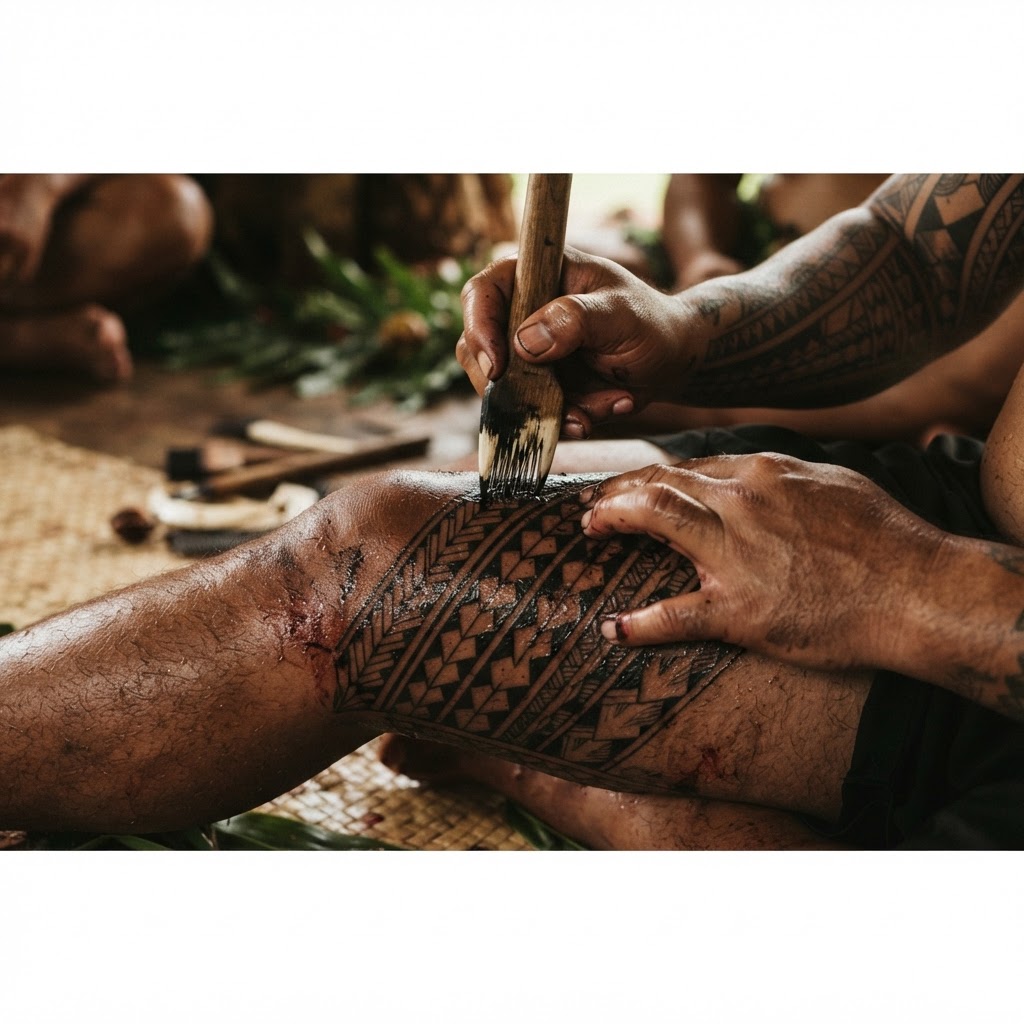
The pe’a is the traditional tattoo for men, covering the body from the waist to the knees. For women, the malu is a more delicate pattern applied to the thighs. Both are administered using traditional tools — a comb of bone or turtle shell attached to a wooden handle, tapped into the skin with a small mallet.
The process is painful, and it is meant to be. The endurance required is part of the meaning. To receive the pe’a is to declare: I am Samoan. I carry my ancestors. I will not turn back.
The tatau is not something you wear. It is something you become.
The Tufuga Ta Tatau
The master tattooist, or tufuga ta tatau, is a highly respected figure in Samoan society. The patterns are not chosen from a catalog — they are determined by family lineage, social rank, and the specific journey of the individual receiving them.
Each geometric pattern, each line, carries a name and a story. The tuaniu (vertical lines), the aso (rafters), the fa’amasina (straight lines) — together they form a visual language that connects the wearer to their family, their village, and their island.
A Living Tradition
Today, the tatau continues. Samoan youth across the diaspora travel back to the islands to receive their pe’a or malu, reconnecting with a heritage that spans oceans and generations. It remains one of the few cultural practices that has survived colonization unbroken — a thread connecting the present to the deepest past.