
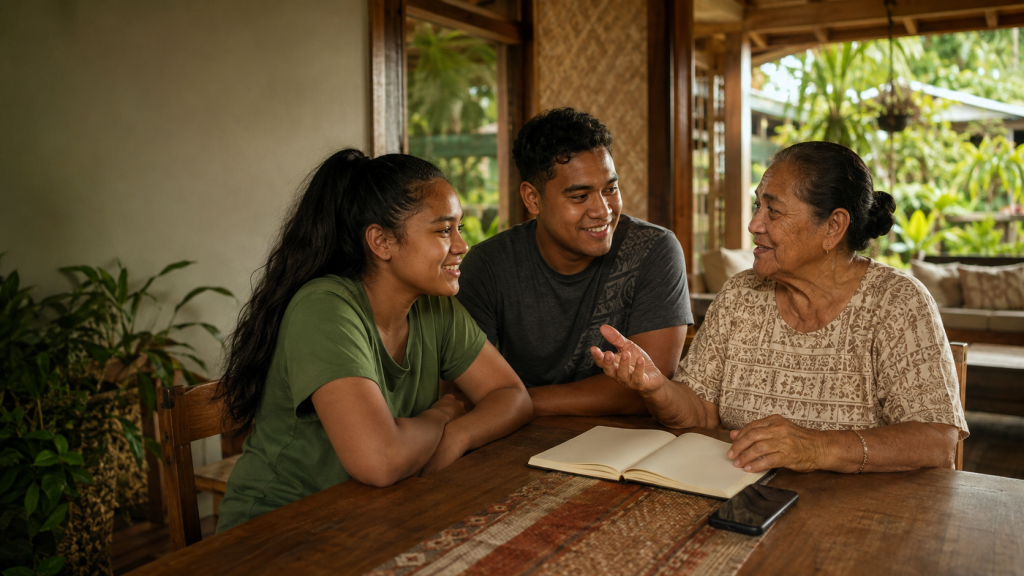
Learning Samoan does not begin with memorizing every grammar rule. It begins with one word spoken with courage.
Maybe that word is tālofa when you greet an elder. Maybe it is faʻafetai when a family member helps you. Maybe it is your first attempt to tell someone your name or the village your family comes from.
Each phrase gives you a way to participate—not perfectly, but sincerely.
For Samoans raised away from the islands, speaking gagana Sāmoa, the Samoan language, can feel deeply personal. You may understand more than you can say. You may worry about making a mistake or being corrected in front of others. That feeling is common, but it should not keep you silent.
Language grows through use. Start with these essential phrases, listen carefully to fluent speakers, and allow yourself to improve one conversation at a time.
As you move toward the midpoint of the article, this paragraph provides an opportunity to connect earlier ideas with new insights. Use this space to present alternative perspectives or address potential questions readers might have. Strike a balance between depth and readability, ensuring the information remains digestible. This section can also serve as a transition to the closing points, maintaining momentum as you steer the discussion to its final stages.
Before You Begin: Pronunciation Matters
Gagana Sāmoa is largely phonetic, meaning the written letters guide you toward the spoken sounds. Every vowel is pronounced, and there are no silent letters in traditional Samoan words.
Keep these fundamentals in mind:
- A sounds similar to the a in “father.”
- E sounds similar to the e in “bed.”
- I sounds similar to the ee in “see.”
- O sounds similar to the o in “more.”
- U sounds similar to the oo in “food.”
- The Samoan g has an ng sound, like the middle of “singer.”
- A macron—the line over a vowel in letters such as ā—shows that the vowel is held longer.
- A glottal stop, written ʻ, creates a brief break in sound. It can distinguish two otherwise similar words.
Do not treat macrons and glottal stops as optional decorations. They can affect both pronunciation and meaning. For example, fai can mean “to do” or “to make,” while faʻi, with a glottal stop, means “banana.”
Written conventions vary among families, communities, and publications, and informal messages often leave diacritical marks out. As a learner, however, noticing them will help you hear and reproduce words more accurately.
Essential Samoan Greetings
Greetings are one of the easiest and most meaningful places to begin.
| Samoan phrase | English meaning | When to use it |
|---|---|---|
| Tālofa | Hello or greetings | A familiar all-purpose greeting |
| Tālofa lava | Warm or respectful greetings | A fuller greeting that adds warmth and sincerity |
| Mālō le soifua | Greetings; good health to you | A respectful greeting, especially appropriate in more formal settings |
| O ā mai oe? | How are you? | When speaking to one person |
| O ā mai oulua? | How are you both? | When speaking to two people |
| O ā mai outou? | How are you all? | When speaking to three or more people |
The word lava strengthens the warmth of tālofa. It is not just “extra vocabulary.” Tone, facial expression, and the relationship between speakers all help communicate respect.
How to answer “How are you?”
You can respond:
O lea ou te manuia, faʻafetai. O ā mai oe?
I am well, thank you. How are you?
In casual conversation, you may also hear a shorter response:
Manuia, faʻafetai.
Well, thank you.
Introducing Yourself
Introductions in Samoan culture can grow into conversations about family, villages, and belonging. Begin with your name, then learn how to share more as your confidence develops.
| Samoan phrase | English meaning |
| O ai lou igoa? | What is your name? |
| O loʻu igoa o [name]. | My name is [name]. |
| O ai lou suafa? | What is your name?—using the respectful word suafa |
| O fea lou nuʻu? | Where is your village? |
| O loʻu nuʻu o [village]. | My village is [village]. |
| Ou te nofo i [place]. | I live in [place]. |
Use igoa for “name” in ordinary conversation. Suafa is a respectful term for a person’s name and may be appropriate when addressing elders, matai, ministers, or others whose role and your relationship call for more formal language.
If you do not yet know your family’s village connections, that is not a reason for shame. Let it become a reason to ask. A conversation with a parent, grandparent, auntie, uncle, or other knowledgeable relative can teach you more than a list of place names ever could.
Polite and Respectful Expressions
Knowing how to ask, thank, excuse yourself, and apologize will take you far in any language. In Samoan, these phrases also support faʻaaloalo—respect shown through words, tone, body language, and conduct.
| Samoan phrase | English meaning | Helpful context |
| Faʻamolemole | Please | Use when making a polite request |
| Faʻafetai | Thank you | Appropriate in everyday situations |
| Faʻafetai lava | Thank you very much | Adds warmth and emphasis |
| Tulou lava | Excuse me; pardon me | Used when passing in front of someone, entering another’s space, or before words that may intrude or offend |
| Faʻamalie atu | I am sorry | A direct apology |
| Faʻamālulu atu | Please forgive me; I apologize | Another respectful form of apology |
Tulou lava deserves special attention. It is more than a substitute for the English phrase “excuse me.” It acknowledges the space and dignity of the people around you. You may hear it when someone passes in front of seated elders, needs to interrupt respectfully, or prepares to discuss something sensitive.
Language and behavior work together. A polite phrase delivered carelessly can still feel disrespectful. A gentle tone, patience, and awareness of where you position your body are also part of communicating well.
Welcoming Someone
Hospitality is central to Samoan family and community life. Two respectful expressions for welcoming someone are:
Maliu mai.
Welcome. Come in.
Afio maia.
Welcome. Come in.
These expressions belong to respectful language, and the most appropriate wording can depend on the person being welcomed and the setting. Listen to how experienced speakers in your family or community welcome elders, matai, ministers, relatives, and friends.
Saying Goodbye and Offering Good Wishes
| Samoan phrase | English meaning | When to use it |
| Tōfā | Goodbye | A common, less formal farewell |
| Tōfā soifua | Goodbye; farewell in good health | A more formal or respectful farewell |
| Lā manuia | Blessings; all the best | A warm expression of good wishes |
| Manuia le aso | Have a blessed or good day | A positive daytime farewell or blessing |
The literal meaning behind a phrase may be richer than its everyday English translation. Tōfā soifua, for example, carries a wish for continued life and well-being, not simply the message “I am leaving now.”
A Simple Conversation to Practice
Read this exchange aloud. Then replace the names and places with your own.
Mele: Tālofa lava. O ai lou igoa?
Sione: Tālofa. O loʻu igoa o Sione. O ai lou igoa?
Mele: O loʻu igoa o Mele. O ā mai oe?
Sione: O lea ou te manuia, faʻafetai. O ā mai oe?
Mele: Manuia, faʻafetai. O fea lou nuʻu?
Sione: O loʻu nuʻu o Safotu.
Mele: Faʻafetai lava. Tōfā soifua.
Sione: Tōfā. Lā manuia.
Do not rush through the exchange. Speak each vowel. Pause at the glottal stops. Repeat the conversation until the phrases begin to feel like complete thoughts instead of separate words.
Everyday Language and Respectful Language
One reason Samoan can feel challenging is that the “correct” word may depend on whom you are addressing and where the conversation is taking place.
Samoan speakers may distinguish among:
- Gagana mo aso uma: everyday or common language
- Gagana faʻaaloalo: respectful language
- Gagana faʻamatai: chiefly or oratorical language
A beginner does not need to master every formal register before speaking. You should, however, understand that respectful vocabulary exists and that direct word-for-word translation will not always capture the social meaning of a phrase.
When speaking with elders or in a cultural, church, or village setting, listen before assuming. Ask a trusted fluent speaker how a phrase should change for the audience. Being willing to learn is itself a form of respect.
A Seven-Day Practice Challenge
You do not need hours of study every day. Ten focused minutes can build a habit.
- Day one: Practice tālofa, tālofa lava, and tōfā.
- Day two: Ask and answer O ā mai oe?
- Day three: Introduce yourself using O loʻu igoa o…
- Day four: Practice faʻamolemole, faʻafetai, and tulou lava.
- Day five: Say your family village using O loʻu nuʻu o… If you do not know it, ask someone in your family.
- Day six: Read the practice conversation aloud three times.
- Day seven: Use at least three phrases in a real conversation, voice message, or family video call.
Recording yourself can help you hear where you hesitate, but compare your pronunciation with a fluent speaker or a trustworthy audio source. English-style phonetic spellings can be useful as a temporary reminder, but they should never replace listening.
Common Questions
Is it disrespectful to speak Samoan if I am not fluent?
No. A sincere effort is usually far more respectful than refusing to try because you fear imperfection. Listen, accept correction graciously, and avoid pretending to know more than you do.
Why do I see the same word written in different ways?
Macrons and glottal stops are frequently omitted in informal writing, and spelling conventions can vary among publishers and communities. These marks still matter because they help distinguish pronunciation and meaning.
Should I learn formal Samoan first?
Begin with everyday phrases while learning that respectful and chiefly forms exist. Let fluent speakers and cultural mentors guide you before using specialized language in formal settings.
What is the fastest way to remember these phrases?
Use them with people. Attach each phrase to a real moment: greeting your family, thanking someone, entering a room respectfully, or ending a phone call. Language becomes memorable when it becomes part of a relationship.
Carry the Language Forward
You do not have to wait until you are fluent to make gagana Sāmoa part of your life.
Say tālofa lava when you enter the room. Say faʻafetai when someone serves you. Ask your relatives O fea lou nuʻu? and listen to the stories that follow. Teach a younger sibling or cousin the phrases you practiced this week.
Every word spoken with care strengthens the connection between language, identity, and family.
The goal is not to perform perfection. The goal is to keep the language living.
Words to Know
- Gagana Sāmoa: The Samoan language
- Faʻa Samoa: The Samoan way of life
- Faʻaaloalo: Respect; honoring people through words and conduct
- Nuʻu: Village
- Igoa: Name in everyday language
- Suafa: A respectful term for a name or title
- ʻĀiga: Family or extended family
Continue Learning
Listen to the greetings and pronunciation recordings provided by the New Zealand Ministry for Pacific Peoples, explore its Gagana Samoa language card, and use the Te Papa Samoan Language Week learning resources for additional practice.